
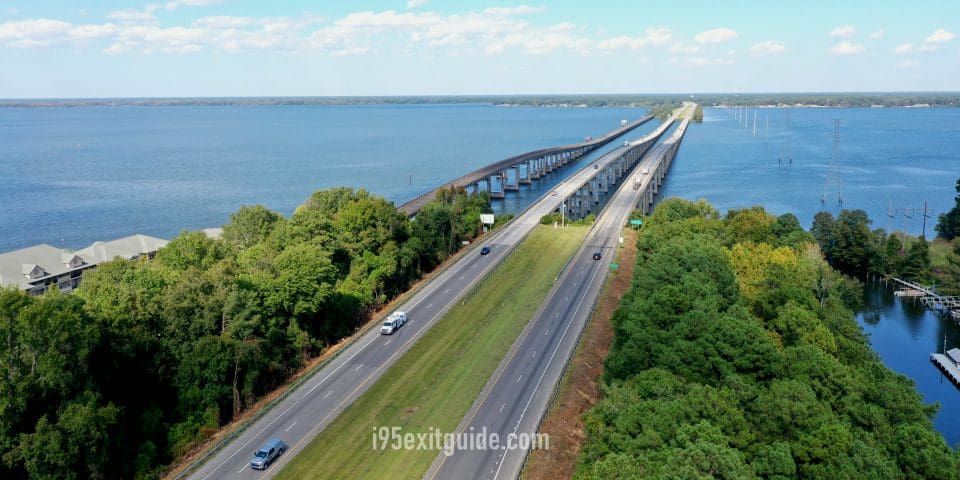
I-95 serves as South Carolina’s primary north-south corridor, linking the state to the East Coast from Florida to Maine. As a critical gateway for commerce, tourism, and daily commuters, I-95 handles millions of vehicles annually, including heavy freight from the Port of Charleston and beyond. The South Carolina Department of Transportation (SCDOT) has launched the I-95 Improvements Program under the banner “Fix the Drive on I-95,” a multi-faceted initiative designed to address longstanding congestion, safety concerns, and infrastructure decay in anticipation of explosive population and economic growth.1 This program encompasses over 200 miles of enhancements, transforming a highway plagued by bottlenecks into a resilient, efficient lifeline for the Palmetto State.
With projections estimating a 50% increase in traffic volumes by 2050 due to industrial expansion, port activities, and migration to coastal areas, SCDOT’s strategy prioritizes proactive investments. Secretary of Transportation Justin P. Powell emphasizes, “Our interstates are a critical component of our success as a state – the safe and efficient movement of goods and people provides the quality of life we enjoy in South Carolina and connects our economy with the world.”1 By 2026, significant milestones have been achieved, including groundbreaking ceremonies and contract awards totaling hundreds of millions, signaling a commitment to long-term mobility.
The Strategic Importance of I-95 to South Carolina’s Economy and Connectivity
I-95 stretches approximately 200 miles through South Carolina, traversing rural Lowcountry regions, urban hubs like Florence and Walterboro, and key junctions with I-26 and I-20. It facilitates over $100 billion in annual economic activity, supporting industries from manufacturing and agriculture to tourism and logistics. The corridor connects the Port of Charleston – the deepest harbor on the East Coast – to national markets, with truck traffic accounting for 70% of freight movement.2
Historically, I-95 has faced criticism for narrow lanes, outdated bridges, and frequent delays, earning notoriety as one of the nation’s more frustrating stretches. Congestion at interchanges like Exit 3 (Hardeeville) and Exit 22 (Ridgeland) exacerbates issues, costing drivers time and businesses productivity losses estimated at $500 million yearly. SCDOT’s program counters this by aligning improvements with state growth forecasts: South Carolina’s population is expected to reach 6 million by 2040, driving demand for enhanced capacity.3
Beyond economics, safety is paramount. Run-off-road crashes, often due to inadequate clear zones, represent 30% of I-95 incidents in the state. The program’s safety upgrades aim to reduce fatalities by widening shoulders and removing roadside hazards, potentially saving hundreds of lives over the next decade.
Regional Impacts Across South Carolina Counties
From Jasper County at the Georgia line to Dillon County near North Carolina, improvements target county-specific needs:
- Lowcountry (Jasper, Beaufort): Widening to combat port-related truck surges.
- Midlands (Orangeburg, Clarendon): Bridge replacements over Lake Marion to handle flood-prone freight.
- Pee Dee (Florence, Dillon): Resurfacing for smoother rural travel.
Core Components of the I-95 Improvements Program
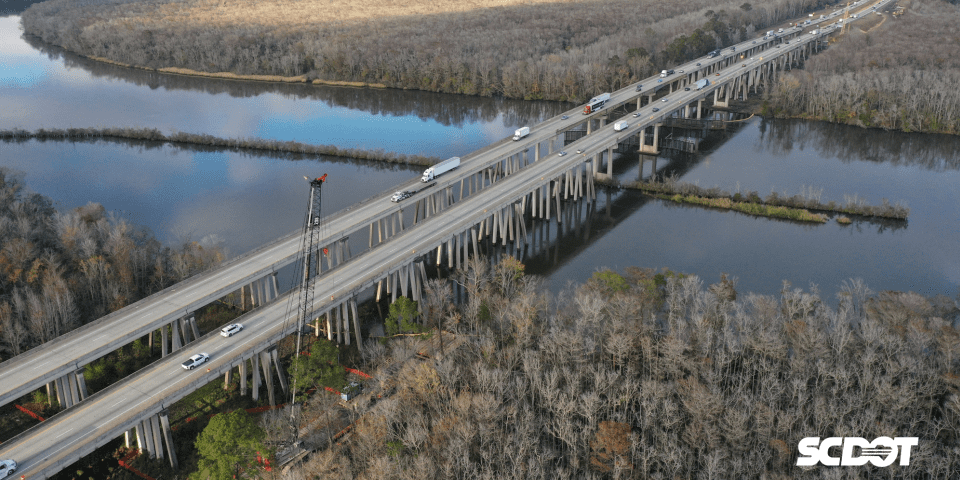
SCDOT’s approach is holistic, dividing efforts into four pillars totaling 245 miles of work. These initiatives, funded through gas tax increases, federal grants, and state bonds, represent a $2+ billion investment phased over a decade.
9 Interchange Improvements and 36 Miles of Widening
Widening I-95 from two to three lanes in each direction at high-congestion zones will boost capacity by 50%, reducing peak-hour delays from 20 minutes to under 5. Key sites include MM 0-8 (Savannah River to US 278), where a $825 million contract – SCDOT’s largest ever – was awarded in June 2025 to Ferrovial for design-build execution.4 This 10-mile segment, groundbreaking held August 2025, includes ramp realignments and ITS (Intelligent Transportation Systems) for real-time traffic management. By March 2026, southbound traffic shifts and drainage works are advancing, with completion slated for 2030.5 6
The I-26/I-95 interchange in Orangeburg County is another focus, with multi-phase reconstructions improving weave lanes and adding auxiliary ramps.7
95 Miles of Resurfacing and Preventive Maintenance
Pavement distress from heavy loads and weather has shortened lane life to 15 years. Resurfacing 95 miles with diamond grinding and thin overlays will extend durability to 25+ years, enhancing ride quality and fuel efficiency. These low-disruption projects use quick-cure materials, minimizing lane closures during off-peak hours.
42 Bridge Improvements
Structurally deficient spans, like those over Lake Marion, pose risks to 100,000 daily users. Replacements feature wider decks, higher clearances for oversized loads, and seismic retrofits. The Lake Marion project alone will install corrosion-resistant designs, supporting freight growth amid $2.7 billion in annual port economic impact.8
103 Miles of Safety Improvements
Clear zone enhancements – flattening slopes, removing fixed objects – comply with American Association of State Highway and Transportation Officials (AASHTO) standards, targeting a 20% crash reduction. Cable barriers and rumble strips further deter cross-median incidents.
Recent Developments and Public Engagement Efforts
As of March 2026, momentum builds:
- Groundbreaking (August 2025): Savannah River to US 278, celebrated by SCDOT and GDOT officials.9
- Public Information Meeting (October 2, 2025): MM 22-33 (Ridgeland to US 17), reviewing third-lane additions.10
- Public Hearing (September 11, 2025): MM 8-21, focusing on capacity upgrades.11
- Progress Updates: Savannah River bridges under construction; northbound lane shifts imminent.12
Challenges persist, such as a February 2026 funding pause for Exit 3 interchange due to financial reviews by the SC Transportation Infrastructure Bank, highlighting the need for stable financing.13 SCDOT maintains robust engagement via project webpages and a video library.
Integration with SCDOT’s Broader Strategic Initiatives

The 10-Year Plan: Restoring Good Repair
Since 2010, SCDOT’s 10-Year Plan has ballooned the construction program from $1 billion (2009) to $6.2 billion (2024), emphasizing maintenance backlogs. I-95 projects form a cornerstone, funded by a 12-cent gas tax hike phased in since 2017.2
Momentum 2050: Vision for Future Prosperity
This statewide multimodal plan, released in 2025, projects $100+ billion in needs through 2050, prioritizing interstates like I-95 as National Highway Freight Network (NHFN) assets. It advocates resilience against sea-level rise, EV infrastructure, and multimodal links (e.g., rail parallels).14 15 Focus areas include rural safety, pavement preservation, and bridge upkeep, positioning South Carolina for GDP growth exceeding 3% annually.
Economic and Safety Benefits: A Multiplier Effect
Each $1 invested in highways yields $5.50 in economic returns via jobs (thousands created in construction) and commerce. I-95 upgrades will decongest routes to Hilton Head and Myrtle Beach, boosting tourism revenues by 15%. Safety gains could avert $1 billion in crash costs over 20 years.
Projected Outcomes:
| Category | Pre-Improvements | Post-Improvements |
|---|---|---|
| Capacity Increase | Baseline | +50% |
| Annual Delay Reduction | 20 min/peak | <5 min |
| Crash Reduction | Baseline | 20% |
| Pavement Life | 15 years | 25+ years |
Challenges, Innovations, and Future Outlook
Funding hurdles, environmental reviews, and supply chain issues pose risks, yet innovations like accelerated bridge construction (ABC) and BIM modeling streamline delivery. By 2030, 80% completion is targeted, with full rollout by 2040 aligning with Momentum 2050.
What’s I-95 traffic like RIGHT NOW? Get Real-time traffic information for cities along Interstate 95. Maps show updates on I-95 road construction, traffic accidents, travel delays and the latest traffic speeds. I-95 traffic cameras show congestion at a glance. Visit I-95 Traffic.
The I-95 Exit Guide is the Internet’s largest and most complete website dedicated to Interstate 95 travelers. Find detailed exit service listings… lodging, camping, food, gas and more for every exit from Maine to Florida!
On the road? Why not take us with you. The I-95 Exit Guide is mobile-friendly and totally FREE. No App Required.
Traveling another route? Visit our growing family of exit guides: I-4 Exit Guide, I-5 Exit Guide, I-10 Exit Guide, I-75 Exit Guide, I-80 Exit Guide and I-95 Exit Guide. Detailed exit service listings… discount lodging, camping, food, gas and more for every exit along the way!