Key Takeaways
- Plan around propane restrictions. The article highlights tunnel restrictions that affect RVs, especially in Baltimore, where it recommends the western I-695 bypass.
- Get your toll setup ready. Verify transponder compatibility along your route, register your RV and trailer or towed vehicle, and keep account details current to avoid billing problems.
- Know your rig’s dimensions. Measure your full height, length, and weight, use RV-specific navigation, and watch for restricted parkways, low bridges, and fuel-station canopies.
- Take bridge winds seriously. Monitor forecasts and official restrictions, and be prepared to wait somewhere safe when crosswinds make travel hazardous.
- Choose routes and timing strategically. The article recommends midday city crossings to reduce rush-hour exposure and presents I-81 as an alternative—with mountain grades, truck traffic, and winter-weather trade-offs.
As late autumn paints the Northeast in vibrant shades of amber and rust, a massive, synchronized migration begins. Every year, hundreds of thousands of snowbirds pack up their homes, hitch up travel trailers, or fire up Class A motorhomes to head south toward sunny skies and palm trees.
For RV travelers living along the East Coast, the path of least resistance on paper is Interstate 95. Stretching over 1,900 miles from the Canadian border in Maine all the way to the southern tip of Miami, I-95 travel represents the most direct vein to warm weather.
However, any seasoned road tripper will tell you that I-95 is a double-edged sword. While it is undeniably the fastest route south, it is also an exhausting gauntlet of aging Infrastructure, high-stakes traffic, aggressive commuters, complex tolling networks, and strict physical barriers. Driving a 40-foot rig or towing a 30-foot trailer through the Northeast corridor can test even the most patient driver. From strict propane rules in Baltimore to bridge-swaying winds in Maryland and cashless toll traps in New York, the route demands respect and meticulous planning.
Navigating I-95 in an RV doesn’t have to be a high-stress nightmare. If you understand state-specific vehicle restrictions, master modern multi-state toll systems, respect physical clearances, and plan strategic city bypasses, you can transform a white-knuckle drive into a smooth, confident journey south.
Part 1: The Tunnel Trap & Propane Restrictions

For typical passenger cars, a tunnel is simply a dark, quick passage beneath a body of water. But for RV travelers hauling liquid petroleum gas (propane) to run their refrigerators, stoves, and furnaces, East Coast tunnels represent absolute brick walls.
Underestimating propane restrictions along the Mid-Atlantic and Northeast coast can lead to immediate rerouting, steep fines, or dangerous situations.
East Coast Tunnel Propane Matrix
| Route/Tunnel | Propane Allowed? | Max Limit/Restriction |
|---|---|---|
| I-95 Fort McHenry (MD) | STRICTLY BANNED | > 10 lbs/cylinder barred |
| I-895 Harbor Tunnel (MD) | STRICTLY BANNED | > 10 lbs/cylinder barred |
| I-695 Key Bridge Detour (MD) | CLOSED* | CLOSED* |
| Lincoln Tunnel (NY/NJ) | STRICTLY BANNED | No Bulk/Open Propane |
| Holland Tunnel (NY/NJ) | STRICTLY BANNED | No Bulk/Open Propane |
| GW Bridge (Lower Level) | STRICTLY BANNED | Use Upper Level Only |
| Chesapeake Bay Tunnel (VA) | ALLOWED W/ INSPECT | Valves MUST be OFF |
* On March 26, 2024 a drifting 947-foot ship struck a main support pier of the bridge at approximately 1:29 a.m., causing major sections of the steel truss bridge to collapse into the Patapsco River.
The Hard Rule of LPG Transport
Transportation agencies enforce strict rules regarding Liquefied Petroleum Gas (LPG) in subterranean structures. Enclosed underwater tunnels lack the natural ventilation required to safely dissipate heavier-than-air gases like propane. In the event of a leak or a collision, trapped gas creates a catastrophic explosion hazard. As a result, states along the I-95 corridor aggressively enforce propane limitations.
The Baltimore Bottlenecks: Fort McHenry & Harbor Tunnels
The most famous surprise for south-bound snowbirds occurs in Maryland. As you approach Baltimore on I-95 South, you are funneled directly toward the Fort McHenry Tunnel (I-95) or the nearby Harbor Tunnel (I-895).
Both of these underwater passages carry strict propane limits:
- The Rule: No vehicle may carry more than 10 pounds of propane per cylinder, with a maximum of 100 pounds total across no more than 10 cylinders.
- The Reality: A small portable 20-lb tank used for a backyard grill breaks this law. The built-in mounted ASME propane tanks on Class A and Class C motorhomes (which often hold 40 to 100+ lbs of fuel) and standard dual 20-lb or 30-lb travel trailer tanks are completely prohibited.
- Enforcement: Transportation authority officers routinely inspect high-profile vehicles before entry. Turning around at a tunnel portal with a 40-foot rig during peak rush hour is stressful, embarrassing, and expensive.
The Fix: The I-695 Bypass
To bypass Baltimore legally and safely, you must take I-695 (the Baltimore Beltway) around the city.
- Western Bypass: Steer your rig onto I-695 West/South (Towson) around the western side of Baltimore. This keeps you entirely on open highway, bypassing the tunnels completely while reconnecting smoothly to I-95 South of the city near Baltimore/Washington International (BWI) Airport.
The New York / New Jersey Crossings

If your migration starts in New England, crossing the Hudson River presents another complex barrier.
Hudson River Crossings Options
- George Washington Bridge (I-95): Hazardous materials, including RV propane tanks, are strictly banned on the lower level of the George Washington Bridge. If you take the GWB, you must stay on the Upper Level. Keep a close eye on lane signage as you approach the bridge from the Cross Bronx Expressway or New Jersey Turnpike.
- Lincoln & Holland Tunnels: Connecting Manhattan to New Jersey, both of these tunnels carry absolute bans on bulk propane. While few RV travelers intend to drive through Midtown Manhattan, GPS navigation software can occasionally recalculate and route unsuspecting drivers toward these passages during traffic jams.
- Verrazzano-Narrows Bridge: While open air, this bridge has strict lane assignments and lower-deck restrictions for high-profile and commercial-style vehicles. Always stick to upper decks when offered a choice.
Part 2: The Cashless Toll Gauntlet & Transponder Strategy

Gone are the days of rolling down your window, handing a crisp five-dollar bill to a toll collector, and getting a friendly wave. The entire Northeast and Mid-Atlantic sections of I-95 have transitioned almost entirely to 100% Cashless Tolling (also known as Open Road Tolling or Toll-by-Plate).
For snowbirds tackling long-distance I-95 travel, this structural shift brings hidden administrative challenges, multi-axle surcharges, and costly processing fees if approached unprepared.
E-ZPass Recognition for Southbound Travelers
| State | Recognition |
|---|---|
| Maine New Hampshire Massachusetts New York New Jersey Pennsylvania Delaware Maryland Virginia North Carolina | Seamless coverage via standard E-ZPass |
| Florida | Requires SunPass PRO, Uni, or compatible E-ZPass |
The Cashless Toll Trap
When you pass under an Open Road Tolling gantry without a compatible transponder:
- High-speed overhead cameras capture your vehicle’s front and rear license plates.
- The state tolling authority searches motor vehicle databases to locate the registered owner.
- A paper invoice is mailed to your physical residence.
For RV travelers who leave their northern homes in November and don’t return until April, these paper bills sit unopened in mailboxes or get forwarded via slow postal routes. By the time you read the bill, the initial $4.00 toll may have accumulated $50.00 to $100.00 in late fees, administrative penalties, and collection notices. Worse yet, unpaid tolls can lead to registration holds in your home state.
The E-ZPass Multi-State Solution
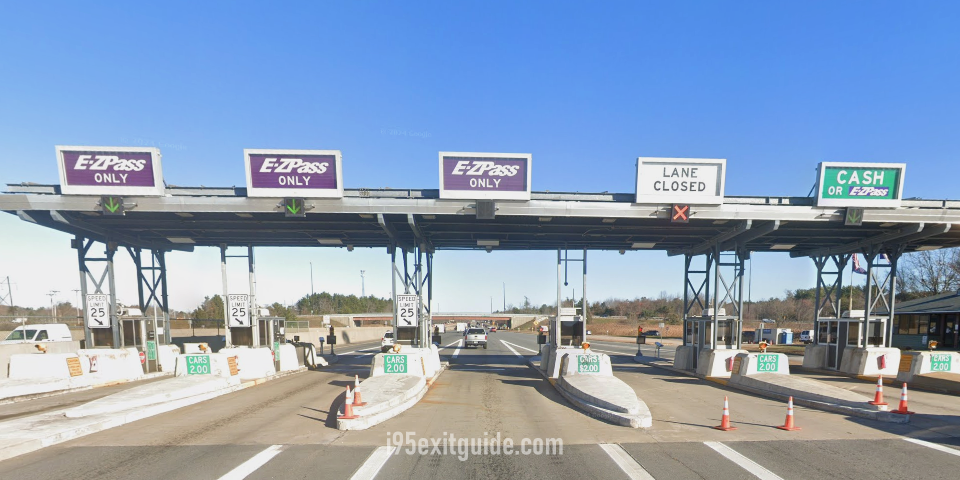
The most efficient tool for surviving northern tolls is an E-ZPass transponder. E-ZPass operates as an umbrella network spanning over 19 states from Maine south to North Carolina, and west past Illinois.
Transponder Compatibility Chart
| Transponder Type | Active Regions | RV Compatibility |
|---|---|---|
| Standard E-ZPass | ME, NH, MA, RI, NY, NJ, PA, DE, MD, VA, NC, WV, OH, IN, IL | participating states |
| SunPass PRO | All E-ZPass states + FL, GA | Excellent choice for Florida-bound snowbirds |
| E-ZPass NC Quick Pass | All E-ZPass states + NC, FL, GA | Ideal for Carolinas and Florida travel |
| Uni (by E-Pass) | 19 E-ZPass states + FL, GA | Works across 19 states; single account management |
- Florida Integration: For years, Florida operated on its own distinct system (SunPass) that was incompatible with northern E-ZPass tags. Today, that barrier is gone. Modern transponders like SunPass PRO, the Uni (formerly E-Pass Xtra), or an E-ZPass NC Quick Pass work seamlessly across both the northern E-ZPass network and Florida’s Turnpike / SunPass express lanes.
- Pro Tip: If you already own an E-ZPass from a state like New York, Massachusetts, or Pennsylvania, verify if your specific agency offers seamless interoperability with Florida’s toll roads. Upgrading to a multi-state unit before departing saves money and administrative frustration.
The “Dual-Axle” & Towed Vehicle (Toad) Trap
Toll structures change dramatically once you step outside the passenger car category. Toll gantries use overhead laser curtains and embedded roadway treadles to count physical vehicle axles and weigh profile heights.
- Adding a Towed Vehicle (Toad): If you drive a Class A motorhome and pull a compact car, or drive a heavy pickup pulling a double-axle travel trailer or fifth wheel, you are no longer a standard 2-axle vehicle. You are operating a 4-axle, 5-axle, or 6-axle combination.
- Exponential Toll Scaling: Toll costs do not scale linearly; they scale exponentially. Crossing the George Washington Bridge or the Delaware River Joint Toll Bridge in a 5-axle RV setup without a properly registered transponder can cost anywhere from three to five times the standard passenger car rate.
Actionable Tip: Registering Your RV and Axles Properly
To avoid triggering automated toll fraud alerts or receiving massive miscalculation fines:
- Log into your Toll Account: Open your E-ZPass, SunPass, or Uni online portal prior to departure.
- Add Your Towed Vehicle’s License Plate: Make sure the license plate of your towed car, travel trailer, or fifth wheel is listed under your master account. If a gantry misses your transponder signal but photographs the rear plate of your towed car, the system will link the charge directly to your account rather than sending a penalty bill.
- Select an RV/Combination Transponder (If Required): Certain states (such as New York and New Jersey) issue specific transponders for heavy vehicles over 7,000 lbs GVWR or multi-axle RV combinations (often coded as E-ZPass Flex or E-ZPass RV). These specialized tags grant access to discounted non-commercial RV rates across toll bridges.
- Proper Transponder Mounting: RV windshields are large, thick, and frequently feature metallic solar tints or internal heating wires. Mount your transponder in accordance with the manufacturer’s directions-typically high in the center of the windshield, clear of metallic tint strips-to ensure overhead gantries read the unit at highway speeds.
Part 3: Bridges, Winds, and Clearance Woes
Driving a 12-foot to 13-foot-6-inch high rig down an open interstate requires heightened situational awareness. While the main lanes of the Interstate Highway System are federally mandated to maintain clear vertical clearances (typically 14 feet in urban zones and 16 feet in rural areas), the infrastructure surrounding I-95 travel is filled with legacy traps.
East Coast Infrastructure Risks
| Location / Asset | Hazard Type | Impact on RV Travelers |
|---|---|---|
| Connecticut & NY Parkways (e.g., Merritt Parkway) | Low Clearance (Arched Bridges <10′) | STRICTLY PROHIBITED for RVs and trailers |
| Historic Fuel Stations | Overhanging Canopies | Risk of roof/AC unit damage |
| Millard E. Tydings Bridge (I-95 over Susquehanna, MD) | High Winds / Gusts | Severe sway risk for high-profile vehicles |
| Arthur Ravenel Jr. Bridge (SC – Optional Bypass) | High Crosswinds | Sway risk during detours around coastal storms |
Low Clearances: Staying Out of the Canopy
The main hazard for snowbirds is rarely the interstate itself-it is the older infrastructure directly off the exit ramps.
The Parkway Trap
In Northeastern states like New York, Connecticut, and New Jersey, many roads designated as “Parkways” (such as the Merritt Parkway / Route 15 in Connecticut or the Garden State Parkway‘s northern reaches) were constructed in the early-to-mid 20th century exclusively for passenger cars.
- These parkways feature decorative stone-arch overpasses with clearances as low as 8 to 10 feet near the outer shoulders.
- Commercial vehicles, motorhomes, travel trailers, and fifth wheels are strictly forbidden on these routes. GPS devices set to “standard car” mode often direct drivers onto these scenic parkways to avoid I-95 delays. Always double-check your route.
Off-Interstate Fuel Depots
Older gas stations along urban stretches of I-95 in Pennsylvania, New Jersey, and Maryland were built long before modern 13-foot-6-inch Class A motorhomes existed. Watch out for low station canopies, sagging overhead utility lines in historic towns, and tightly angled fuel station entrances that can scrape your rear bumper or rip off air conditioning units.
High-Wind Hazards: High-Profile Drivers Beware
A motorhome or travel trailer presents a massive flat side wall to crosswinds. When driving over elevated bridges along the Atlantic seaboard, sudden gusts can create severe sway, lane drift, or loss of control.
Crucial Bridge Crossings to Monitor
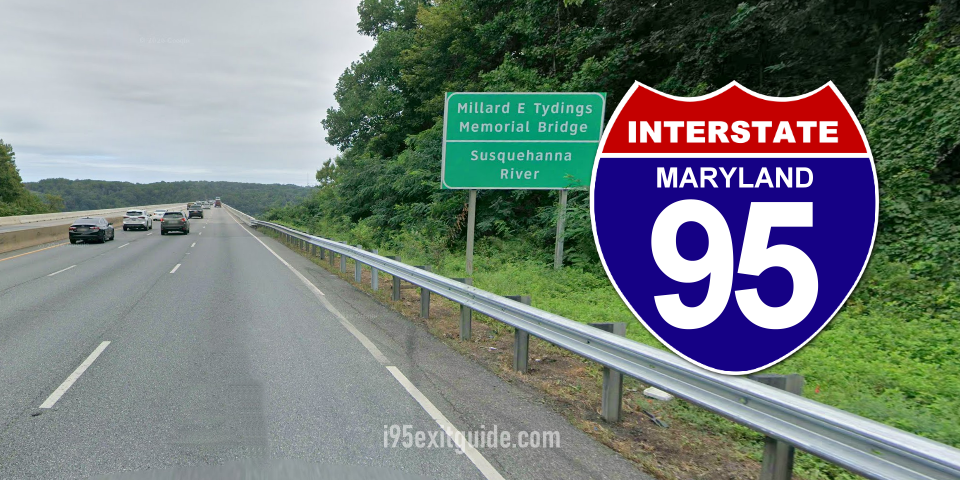
- Millard E. Tydings Memorial Bridge (I-95 over the Susquehanna River, MD): Rising over 100 feet above the water, this bridge is notorious for sudden lateral gusts sweeping down the river valley. The Maryland Transportation Authority regularly issues wind warnings or restricts high-profile vehicles when wind speeds cross specific thresholds.
- Thomas J. Hatem Memorial Bridge (US-40, MD): The local alternative to the Tydings Bridge, this crossing is equally vulnerable to high winds off the Chesapeake Bay basin.
- Arthur Ravenel Jr. Bridge (US-17, Charleston, SC): If your journey takes you off I-95 toward coastal South Carolina, this massive cable-stayed bridge exposes high-profile vehicles to strong, ocean gusts.
- Cape Fear River Bridges (NC): Multiple elevated crossings in eastern North Carolina sit in open coastal terrain where sudden weather fronts generate intense crosswinds.
Wind Mitigation Strategy
To protect your rig and maintain control during high-wind situations:
Wind Speed Action Scale for High-Profile Vehicles
| Wind Speed | Action |
|---|---|
| 0 – 15 MPH | Normal driving conditions. |
| 16 – 25 MPH | Heightened alertness required. Reduce speed by 5-10 mph. |
| 26 – 34 MPH | Moderate risk. Trailer sway increases. Seek right-hand lane. |
| 35+ MPH | HIGH RISK. Pull over at safe rest area/truck stop and wait. |
- Check Wind Apps Daily: Never rely solely on temperature forecasts. Download specialized wind-tracking apps like Windy or RadarOmega. Pay close attention to sustained wind speeds and peak gust predictions along your planned stretch of highway.
- Establish a Hard Cutoff: Make it a firm personal rule to pull off the highway if sustained crosswinds exceed 30 to 35 mph. The small delay of waiting out a wind front is vastly preferable to dealing with a jackknifed trailer or flipped rig.
- Know Where to Wait: If winds pick up unexpectedly while approaching a major bridge, pull into the last available rest stop, welcome center, or commercial truck stop prior to the crossing.
Part 4: Strategic Bypasses (How to Skip the Worst of It)
One of the biggest mistakes inexperienced RV travelers make is assuming that staying on I-95 continuously is the best choice. Between northern New Jersey and Richmond, Virginia, I-95 passes directly through some of the densest metro areas in North America. Strategic detours and calculated timing are essential to preserving your nerves, fuel, and vehicle.
The Mid-Atlantic Bypass Strategy (Southbound)
| Option 1: The Standard Beltways (I-695 / I-495) |
| – Use I-695 West around Baltimore (Avoids Tunnels) – Use I-495 Inner/Outer Loop around Washington D.C. – Strict timing window required (10:00 AM – 2:00 PM) |
| Option 2: The Appalachian Alternative (I-81) |
| – Ditch I-95 in Pennsylvania/New Jersey -> Take I-78 to I-81 South – Traverse Virginia mountains on I-81 – Cut back east via I-77/I-26 or I-64/US-29 – Pros: Zero major urban tunnels, fewer tolls, scenic – Cons: Steep mountain grades, heavy semi truck traffic, possible snow |
The Washington D.C. / Baltimore Escape Strategy
The 40-mile stretch between northern Baltimore and southern Washington D.C. is one of the most heavily congested driving corridors in the United States. Navigating this area in an RV requires precision.
Baltimore Corridor (I-695)
As detailed in Part 1, you must avoid the underwater tunnels on I-95 and I-895.
- Take the I-695 Western Bypass.
- Keep a safe following distance, stay in the center-right lanes to avoid sudden exit-only merges, and maintain steady momentum.
Washington D.C. Corridor (I-495 Capital Beltway)
I-95 does not cut straight through the center of Washington D.C. Instead, it hits the I-495 Capital Beltway, splitting into an Eastern Loop and a Western Loop before continuing south toward Virginia.
- The Western Loop (I-495 West/South through Montgomery County, MD & Fairfax County, VA): Sweeps around northern D.C., crossing the Potomac River via the American Legion Memorial Bridge. This route features rolling hills, variable lane widths, and high-volume commuter traffic.
- The Eastern Loop (I-495 South/East through Prince George’s County, MD): Signs will show I-95 South merging directly onto the Eastern Loop of I-495. This leg takes you over the Woodrow Wilson Memorial Bridge into Alexandria, Virginia.
- The Verdict: The Eastern Loop (I-95/I-495) is generally the preferred route for long-distance southbound RV traffic because it is slightly shorter and avoids the steep, rolling terrain of the Maryland suburbs. However, if major accidents block the Wilson Bridge, the Western Loop serves as an acceptable alternate route.
The Ultimate Long-Cut: The I-81 Mountain Alternative
For snowbirds who want to avoid the high stress, heavy traffic, and frequent tolls of the coastal urban corridor entirely, there is a popular inland alternative: Interstate 81.
I-95 Coastal vs. I-80 Inland Route Comparison
| Feature | I-95 Coastal Route | I-80 Inland Route |
|---|---|---|
| Traffic Density | Extreme (Major Cities) | Moderate (Heavy Truck Volume) |
| Toll Costs | High (Tolls in ME to VA) | Low to Zero (State Dependent) |
| Elevation / Terrain | Mostly Flat Coastal Plain | Mountainous (Appalachian Mts) |
| Propane Restraints | Strict (Multiple Tunnels) | Non-Existent on main highway |
| Gas Station Spacing | Frequent, but tight lots | Frequent, large truck stops |
How the I-81 Route Works
- From New England or New York, route west onto I-78 West or I-80 West across Pennsylvania.
- Intersect I-81 South near Harrisburg, Pennsylvania.
- Travel south along I-81 through the scenic Shenandoah Valley of Virginia, passing through Maryland and West Virginia.
- Cut back east toward I-95 in North Carolina or South Carolina using I-77 South to I-26 East, or I-64 East to US-29.
Pros of the I-81 Alternative
- Fewer Tolls: You bypass nearly all major toll roads in New Jersey, Delaware, and Maryland.
- No Major Tunnels: You eliminate propane restrictions and tunnel detours.
- Less Urban Gridlock: You completely skip NYC, Philadelphia, Baltimore, D.C., and Richmond.
Cons of the I-81 Alternative
- Mountain Grades: You will encounter long, steep climbs and descents along the Appalachian Mountains. Ensure your engine cooling system and transmission fluid are in peak condition, and verify your RV or tow vehicle brakes are in top shape.
- Heavy Freight Traffic: I-81 is a major regional freight corridor. You will drive alongside long lines of heavy commercial semi-trucks, often traveling at high speeds in narrow two-lane stretches.
Timing the Big Cities: The Golden Hour Window
If you choose to stick to I-95 travel, timing your passage through major metropolitan zones is the single most important factor for a smooth trip.
Daily Metro Timing Windows for I-95 RV Travelers
| Time Frame | Window | Conditions |
|---|---|---|
| 12:00 am – 6:00 am | Night Window | Low traffic; watch for road construction. |
| 06:00 am – 10:00 am | Morning Rush | DO NOT ENTER METRO ZONES. Severe delays. |
| 10:00 am – 2:00 pm | Golden Window | OPTIMAL DRIVE TIME. Clear urban corridors. |
| 2:00 pm – 7:00 pm | Evening Rush | DO NOT ENTER METRO ZONES. Heavy gridlock. |
| 7:00 pm – 12:00 am | Night Window | Traffic clears; good driving conditions. |
The Golden Rule: 10:00 AM to 2:00 PM
The optimal window for navigating New York, Philadelphia, Baltimore, D.C., and Richmond is between 10:00 AM and 2:00 PM. During these hours, morning rush hour traffic has dissipated, and evening commuter gridlock has not yet begun.
The Evening Option: After 8:00 PM
If you are comfortable driving your rig at night, tackling major metropolitan stretches after 8:00 PM provides clear, open lanes. However, keep in mind that night driving along I-95 often brings high-speed lane closures for active road maintenance and construction projects.
Avoid Fridays at All Costs
Never attempt to drive through Mid-Atlantic urban centers on a Friday afternoon. Weekend getaway traffic blends with weekday commuter rush hours as early as 1:00 PM, creating gridlock that can extend well into the evening.
Part 5: Essential Pre-Trip Checklist for Snowbird RV Travelers
Before turning the key and launching your southward migration on I-95, review this essential pre-trip checklist designed specifically for high-profile vehicles and multi-state travelers:
Pre-Trip Preparation Checklist
- MEASURE RIG HEIGHT: Confirm exact clearance including AC units.
- UPDATE TOLL ACCOUNTS: Add trailer/toad plates to E-ZPass/SunPass.
- MOUNT TRANSPONDER: Position high on windshield, away from tint.
- ROUTE AROUND TUNNELS: Plan I-695 detour for Baltimore LPG rules.
- CHECK WEATHER & WIND: Monitor forecasts for key bridge crossings.
- VERIFY RV GPS: Input vehicle dimensions into dedicated RV GPS.
- SCHEDULE CITY PASSAGES: Aim for 10:00 AM – 2:00 PM travel windows.
- Verify Physical Dimensions: Know your exact height (measured from the top of your roof air conditioner or satellite dish down to the pavement), total length, gross weight, and overall width. Write these numbers on a sticky note and place it directly on your dashboard.
- Setup a Dedicated RV GPS: Never rely exclusively on standard smartphone navigation apps like Apple Maps or standard Google Maps. These systems assume you are driving a small sedan and will willingly route you into low clearance arches, restricted parkways, or forbidden tunnels. Invest in a dedicated RV GPS unit (e.g., Garmin RV series) or a subscription-based app (e.g., RV Life App, CoPilot RV) that allows you to input your rig’s exact height, weight, length, and propane status.
- Inspect Tires and Inflation Pressures: Sustained high-speed driving along concrete expansion joints on I-95 generates significant heat in RV tires. Check your cold tire pressures every morning using a quality digital tire pressure gauge, and consider installing a Tire Pressure Monitoring System (TPMS) to track real-time temperatures and pressures while on the move.
- Prepare an Emergency Roadside Kit: Ensure you carry heavy-duty warning triangles, reflective vests, a high-capacity hydraulic jack, spare tire assemblies for both tow vehicle and trailer, and an active roadside assistance service plan tailored for large recreational vehicles (such as Coach-Net or CAA/AAA RV coverage).
Conclusion: Preparation Equals Peace of Mind
The annual migration south should be an exciting prelude to a relaxing winter season, not a high-stress endurance test. While I-95 travel presents real challenges-from strict propane tunnel bans in Baltimore to high-wind bridge crossings and complex multi-axle toll networks-these obstacles are completely manageable with the right preparation.
By securing a compatible multi-state transponder, monitoring wind warnings over major river bridges, mapping out your bypass routes, and scheduling your drives around metropolitan rush hours, you can take control of your journey.
As you clear the rolling hills of northern Virginia, watch the highway open up into the pine forests of the Carolinas, and feel the cold air fade into warm southern breezes, you’ll know that your careful planning paid off. The reward for mastering the I-95 corridor is waiting for you at the end of the road: a warm, stress-free winter under sunlit skies.
Join the Snowbird Community!
Are you an experienced snowbird with tips for navigating the East Coast? Have a favorite campsite, roadside stop, or bypass route that makes your drive south smoother? Share your best I-95 survival tips and questions in the comments below!
The I-95 Exit Guide is the Internet’s largest and most complete website dedicated to Interstate 95 travelers. Find detailed exit service listings… lodging, camping, food, gas and more for every exit from Maine to Florida!
On the road? Why not take us with you. The I-95 Exit Guide is mobile-friendly and totally FREE. No App Required.
Traveling another route? Visit our growing family of exit guides: I-4 Exit Guide, I-5 Exit Guide, I-10 Exit Guide, I-75 Exit Guide, I-80 Exit Guide and I-95 Exit Guide. Detailed exit service listings… discount lodging, camping, food, gas and more for every exit along the way!