The Francis Scott Key Bridge, a critical component of I-695 spanning the Patapsco River near Baltimore, Maryland, tragically collapsed on March 26, 2024, after a collision with the container ship Dali, claiming six lives and disrupting one of the East Coast’s busiest ports.1 2 Managed by the Maryland Transportation Authority (MDTA), the replacement project has advanced rapidly through a progressive design-build approach with Kiewit Corporation, aiming to restore connectivity while incorporating modern safety standards. As of March 2026, the initiative reflects a commitment to resilience, with demolition complete and foundational work underway.3
Replacement of the Francis Scott Key Bridge restores the beltway bypass for I-95 north-south travelers avoiding Baltimore tunnels and city traffic, reducing regional delays.
Current Status and Project Phases
The Francis Scott Key Bridge rebuild is progressing through structured phases, leveraging innovative procurement to accelerate delivery. Pre-construction activities kicked off in summer 2024 with the award of the progressive design-build contract, followed by federal approvals like the FHWA’s NEPA documentation and U.S. Army Corps of Engineers permits by spring 2025.1 Demolition of the existing structure began in summer 2025, enabling site preparation, while noise and vibration monitoring and property inspections ensured minimal community disruption.
By fall 2025, key milestones of the Francis Scott Key Bridge replacement project included the launch of the Test Pile Program—driving massive steel piles into bedrock to verify soil stability—and community engagement tools like text alerts and the KEYnected newsletter. 1 As of early 2026, the project reached 70% design completion in just 14 months, a feat attributed to collaborative federal-state efforts, including $500 million in upfront state funding to expedite progress.3 4 Groundbreaking for major construction is imminent, with the “real” start anticipated in spring 2026 following Phase 1 negotiations with Kiewit. Current efforts focus on pier foundations and marine approaches, with over half the deck requiring offshore construction.5
Key Milestones Achieved
- Permitting and Design (2024-2025): All environmental and navigation permits secured; design concept unveiled February 2025.
- Demolition and Testing (2025): Bridge remnants cleared; test piles installed.
- Ongoing (2026): Foundation work and detailed engineering refinement.1
Updated Timeline and Budget
Initial post-collapse estimates pegged the project at $1.7-1.9 billion with a fall 2028 reopening, but November 2025 updates from MDTA revised this substantially. The new Francis Scott Key Bridge replacement cost range stands at $4.3-5.2 billion, more than double the original, driven by a 72% surge in highway construction costs, inflation, and federally mandated enhancements.3
The anticipated open-to-traffic date has shifted to late 2030, a two-year delay, to accommodate a longer main span and robust protections. Negotiations with Kiewit aim to lock in final pricing within this range, supported by federal reimbursements and state bonds. Recent high-level meetings between Governor Wes Moore and U.S. Transportation Secretary Sean Duffy in January 2026 emphasized acceleration, positioning the project as the fastest major U.S. reconstruction.6 4
New Bridge Design Features
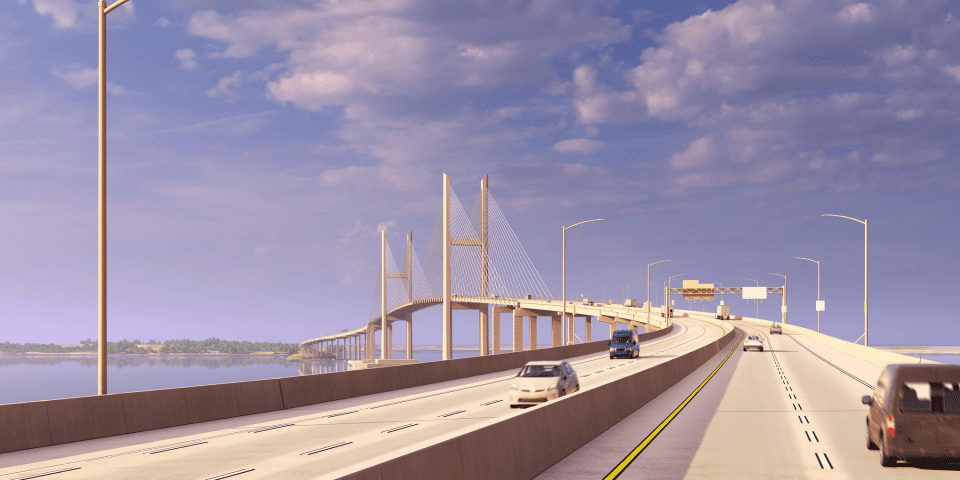
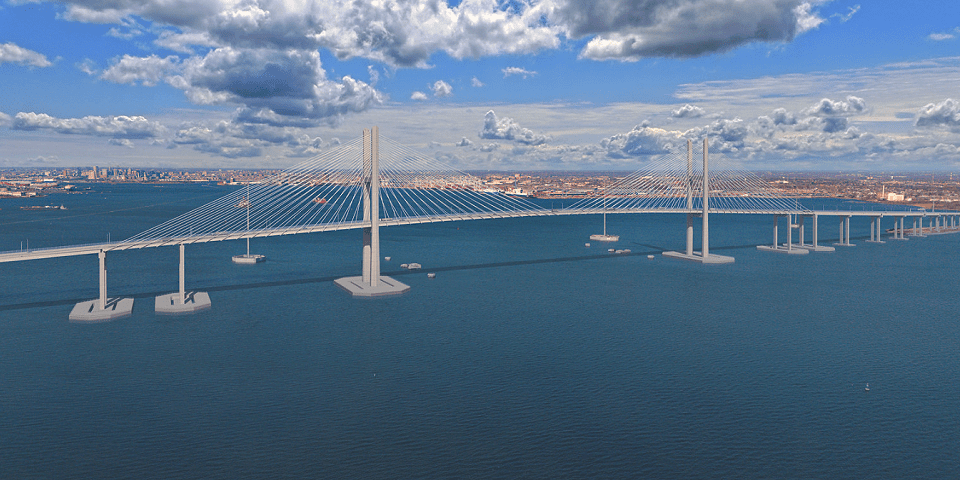
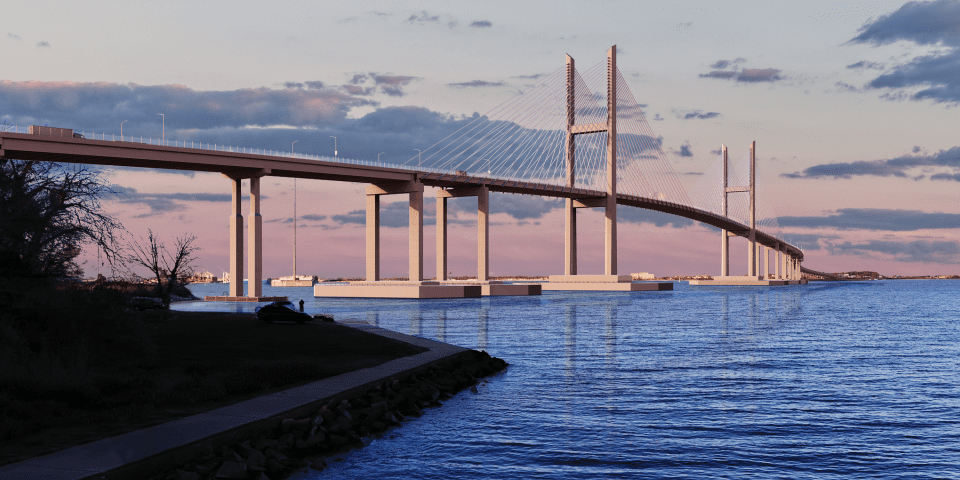
Unveiled by Governor Moore on February 4, 2025, the replacement Francis Scott Key Bridge is Maryland’s first cable-stayed highway bridge, eclipsing the original 1970s steel truss design in scale and safety.2 Stretching 11,015 feet—over two miles—the structure features a 3,365-foot cable-stayed main span with 144 cables distributing weight evenly, flanked by marine and land approach spans.
Structural Innovations
- Main Span and Towers: 1,665-foot span (U.S.’s longest cable-stayed), supported by two 600+ foot pylons, each with 45 steel piles (200+ feet long, 8 feet diameter) and massive 20-foot-thick footings equivalent to two NBA courts.
- Pier Protection: NFL-field-sized fenders (20+ feet thick, 41,600 cubic yards concrete) on main pylons, using 276 concrete-filled steel piles to withstand vessel impacts per AASHTO standards.2
Roadway and Safety Enhancements
The Francis Scott Key Bridge replacement will have four 12-foot lanes per direction, 10-foot outer/4-foot inner shoulders, concrete median, 42-inch barriers, anti-climb fencing, and street lighting meet modern Interstate specs. A 230-foot vertical clearance above the federal channel accommodates larger ships, with 5-foot maintenance walkways and setback cables for wind resistance. Approach spans include curved steel girders (marine) and concrete girders (land), totaling nearly 98,000 square yards of deck.2
Summary
The Francis Scott Key Bridge replacement project stands as a testament to resilient infrastructure recovery, transforming tragedy into a state-of-the-art lifeline for Baltimore. Despite escalated costs and timelines, advancements in design—boasting unprecedented span length, dolphin protections, and heightened clearance—promise enhanced safety and capacity for decades.3 2 With construction ramping up in 2026 and federal backing, the late 2030 opening will reconnect commerce and communities, underscoring Maryland’s resolve. Stay informed via MDTA updates for the journey ahead.
What’s I-95 traffic like RIGHT NOW? Get Real-time traffic information for cities along Interstate 95. Maps show updates on I-95 road construction, traffic accidents, travel delays and the latest traffic speeds. I-95 traffic cameras show congestion at a glance. Visit I-95 Traffic.
The I-95 Exit Guide is the Internet’s largest and most complete website dedicated to Interstate 95 travelers. Find detailed exit service listings… lodging, camping, food, gas and more for every exit from Maine to Florida!
On the road? Why not take us with you. The I-95 Exit Guide is mobile-friendly and totally FREE. No App Required.
Traveling another route? Visit our growing family of exit guides: I-4 Exit Guide, I-5 Exit Guide, I-10 Exit Guide, I-75 Exit Guide, I-80 Exit Guide and I-95 Exit Guide. Detailed exit service listings… discount lodging, camping, food, gas and more for every exit along the way!